
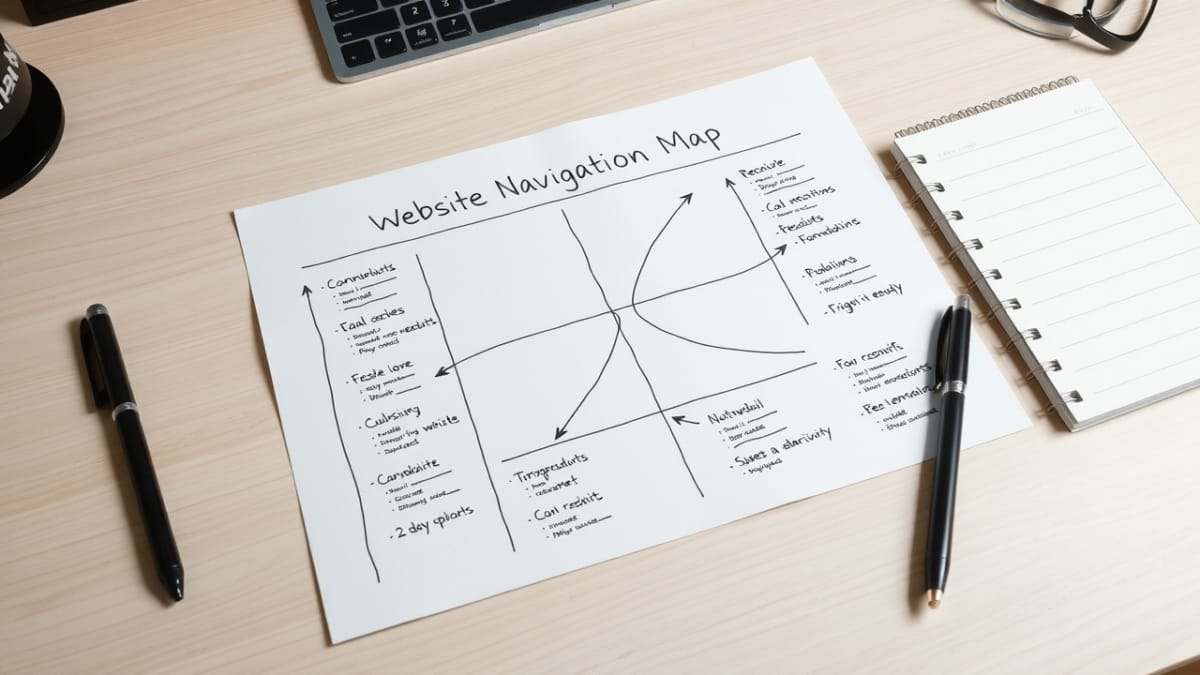
This checklist defines the site’s primary navigation structure and landing page map before menus, internal linking, or content publishing begins. Its purpose is to prevent unclear entry points, URL collisions, and navigation drift.
Navigation decisions made here are structural and long‑lived and should not change frequently once implementation begins.
Checklist Objective
Produce a clear, documented map of top‑level navigation items and their corresponding landing pages, including responsibility boundaries for each.
Preconditions
- Planning 01 — Site Purpose & Scope Definition is completed and approved
- Planning 02 — Content System & Page Model is completed and approved
Checklist Steps
- Identify all top‑level navigation items.
- List primary sections only
- Avoid submenus at this stage
- Map each navigation item to a single landing page.
- Confirm one‑to‑one relationships
- Do not point navigation items to categories or archives
- Define the responsibility of each landing page.
- State what content belongs under each landing page
- State what content explicitly does not belong there
- Confirm URL and slug boundaries.
- Ensure landing page slugs do not collide with posts or taxonomies
- Confirm category slugs use a non‑canonical suffix
- Define footer‑only pages.
- Identify utility and trust pages (About, Contact, Policies)
- Confirm exclusion from primary navigation if intentional
- Review alignment with downstream planning rules.
- Read titles only
- Confirm navigation supports URL and indexing rules
- Related planning:
Required Output
- Final list of top‑level navigation items
- Assigned landing page for each navigation item
- Defined responsibility boundaries per landing page
- Confirmed slug and URL safety
- Identified footer‑only pages
Pause & Lock
Once approved, navigation and landing page assignments become locked inputs for menu creation, internal linking, and content publishing.
Outputs from this checklist are required context for Planning 04 — URL, Slug & Taxonomy Rules .