
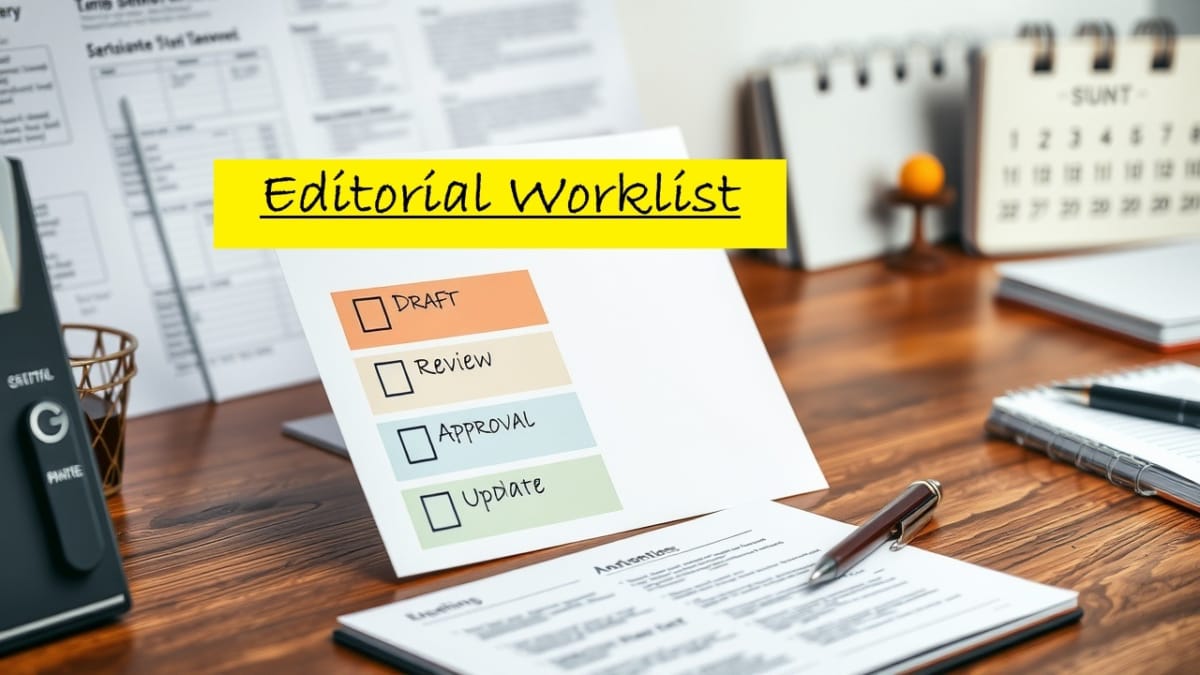
This checklist defines how content is created, reviewed, approved, and modified over time. Its purpose is to prevent content drift, inconsistent updates, and undocumented changes.
Editorial workflow and change control apply to all pages and posts once planning is complete.
Checklist Objective
Establish a clear, documented workflow for content creation and ongoing change management.
Preconditions
- Planning 01 — Site Purpose & Scope Definition is completed and approved
- Planning 02 — Content System & Page Model is completed and approved
- Planning 03 — Navigation & Landing Page Map is completed and approved
- Planning 04 — URL, Slug & Taxonomy Rules is completed and approved
- Planning 05 — Indexing, Visibility & Crawl Control is completed and approved
- Planning 06 — SEO Execution & Governance Rules is completed and approved
Checklist Steps
- Define content creation stages.
- Draft
- Review
- Approved
- Published
- Define review requirements.
- Confirm what must be reviewed before approval
- Identify who performs reviews
- Define approval criteria.
- Confirm when content is considered complete
- Define readiness for indexing eligibility
- Define change control rules.
- Identify what changes require review
- Identify minor changes that do not
- Define documentation requirements for changes.
- Confirm how changes are recorded
- Define when change notes are required
- Define update cadence.
- Confirm how often content is reviewed
- Avoid reactive or unnecessary updates
- Review alignment with downstream operations.
- Read operation titles only
- Confirm workflow supports long‑term maintenance
- Related operations:
Required Output
- Defined content creation stages
- Review and approval requirements
- Change control rules
- Documentation standards for changes
- Update and review cadence
Pause & Lock
Once approved, editorial workflow and change control rules become locked inputs for publishing and ongoing content maintenance.
Outputs from this checklist are required context for Planning 08 — Performance, Maintenance & Lifecycle Assumptions .